Built in Victoria, for Victorian schools · VCE Units 1–4

VCE content, still in memory in October.

Viden turns the Victorian Teaching and Learning Model's own practices — spaced retrieval, revisit and review, consolidation — into something every student does daily, and every teacher can see. Foundations build from Unit 1 — the retention work compounds hardest where it counts most, through the Unit 3 & 4 exam year.

VTLM 2.0-aligned FISO 2.0 assessment data Zero marking load Australian-hosted Built to ST4S 2025.1
0
VCE studies covered, Units 3&4
0
practice questions, Units 1–4
d≈0.50
retrieval-practice effect, 222 classroom studies
0
hours of marking created for teachers
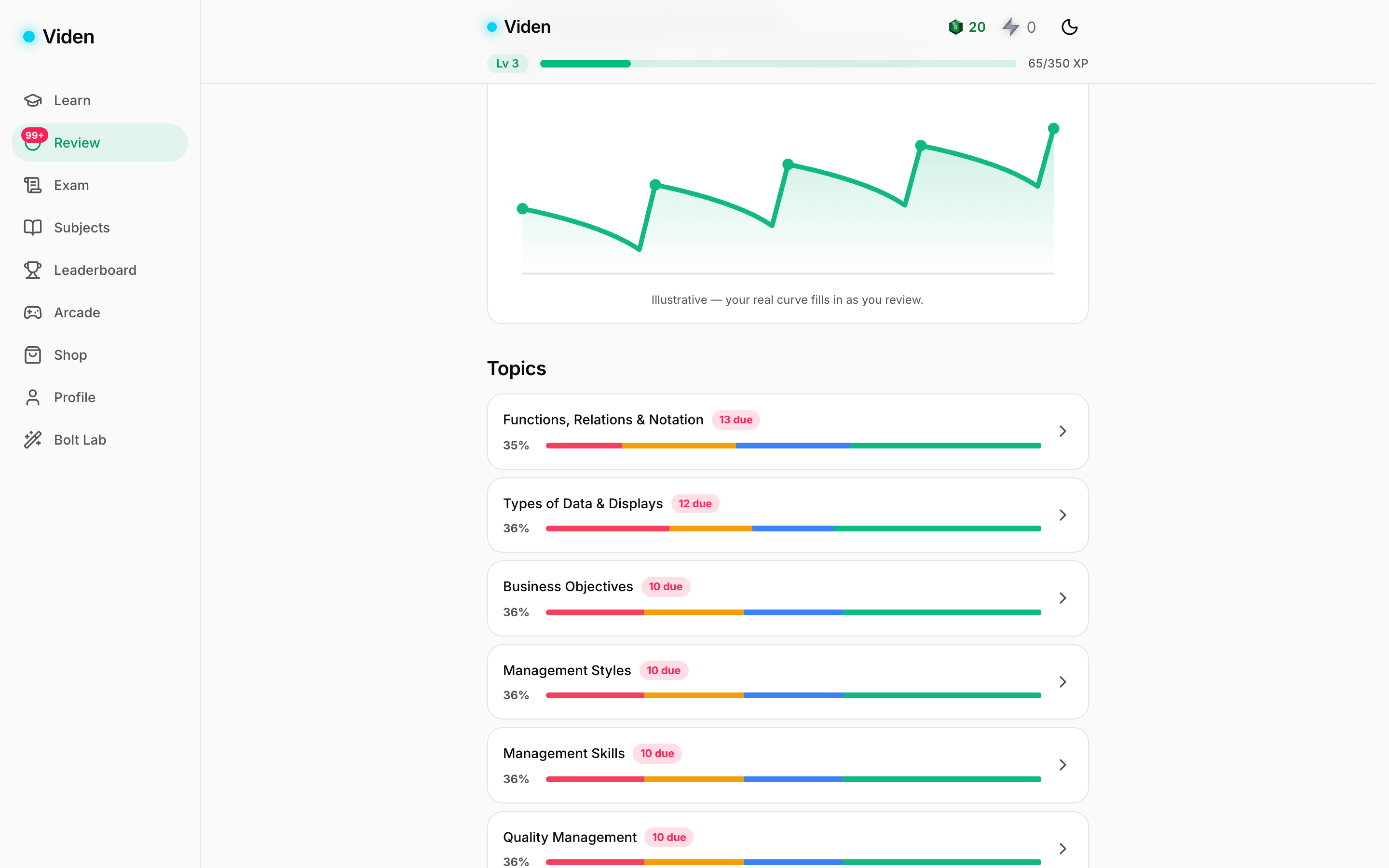
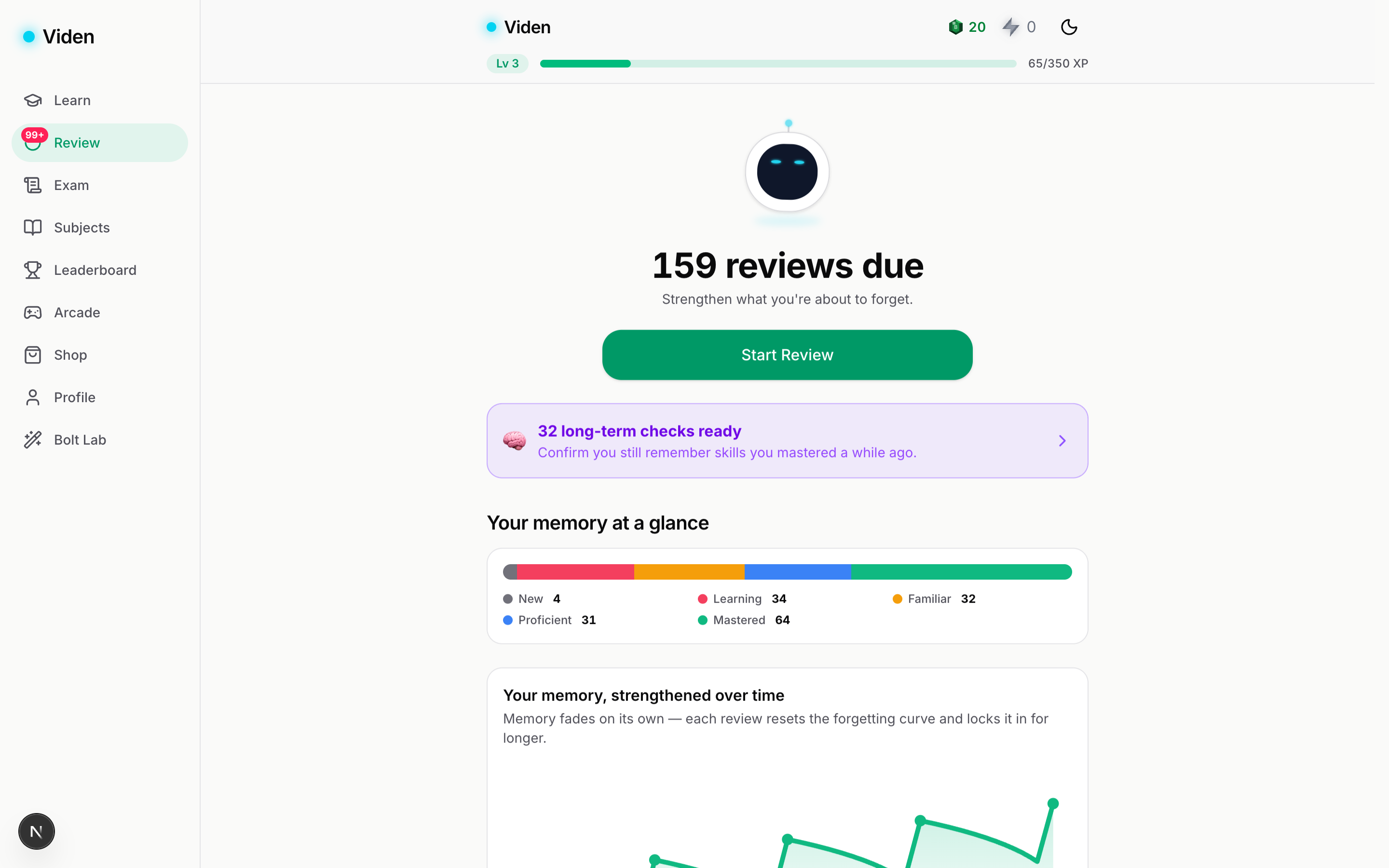
Viden review screen: reviews due, a memory-state breakdown, and a memory-strength chart.
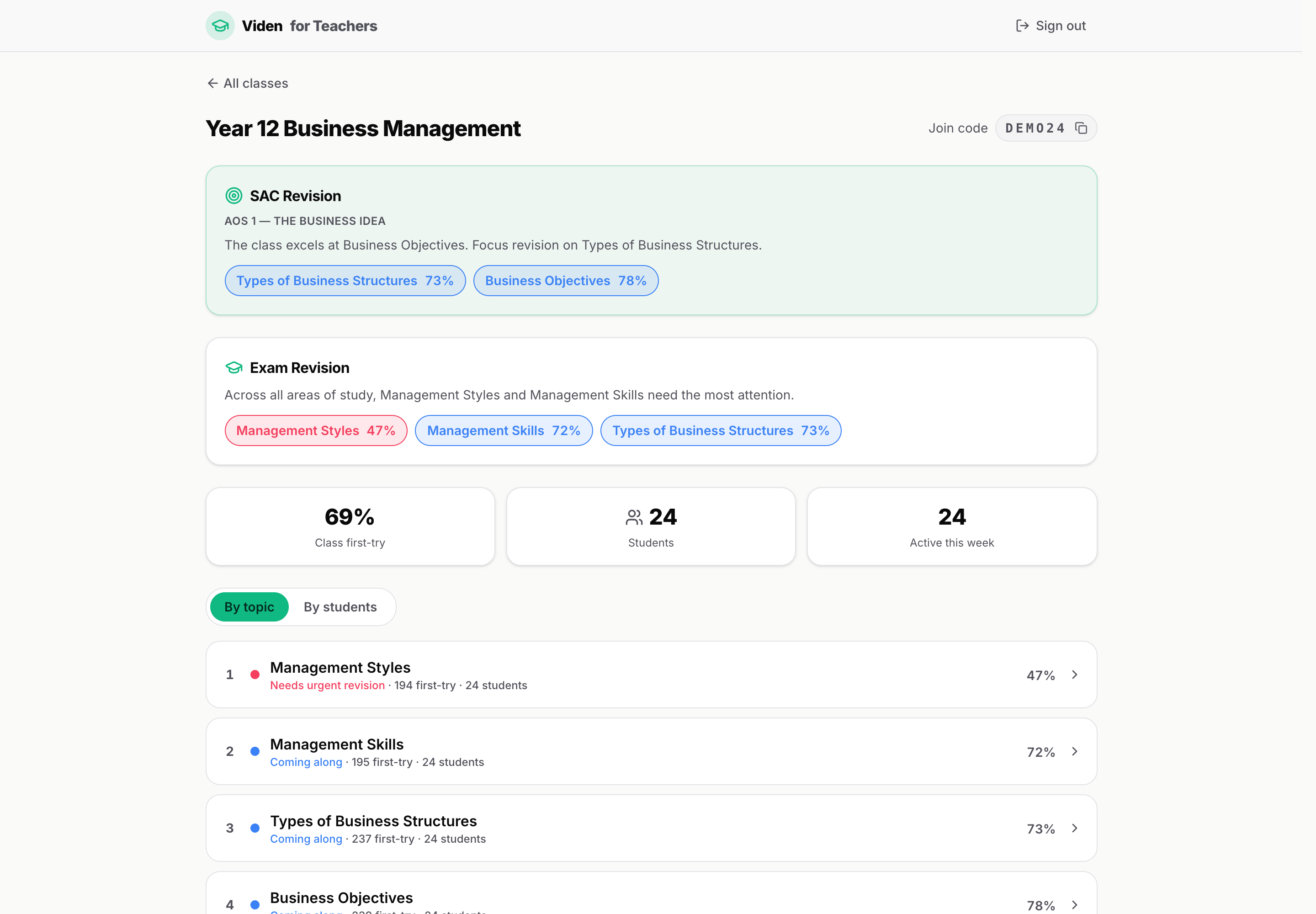
Viden teacher class view showing SAC and exam revision recommendations, class accuracy, and a topic list ranked by weakness.
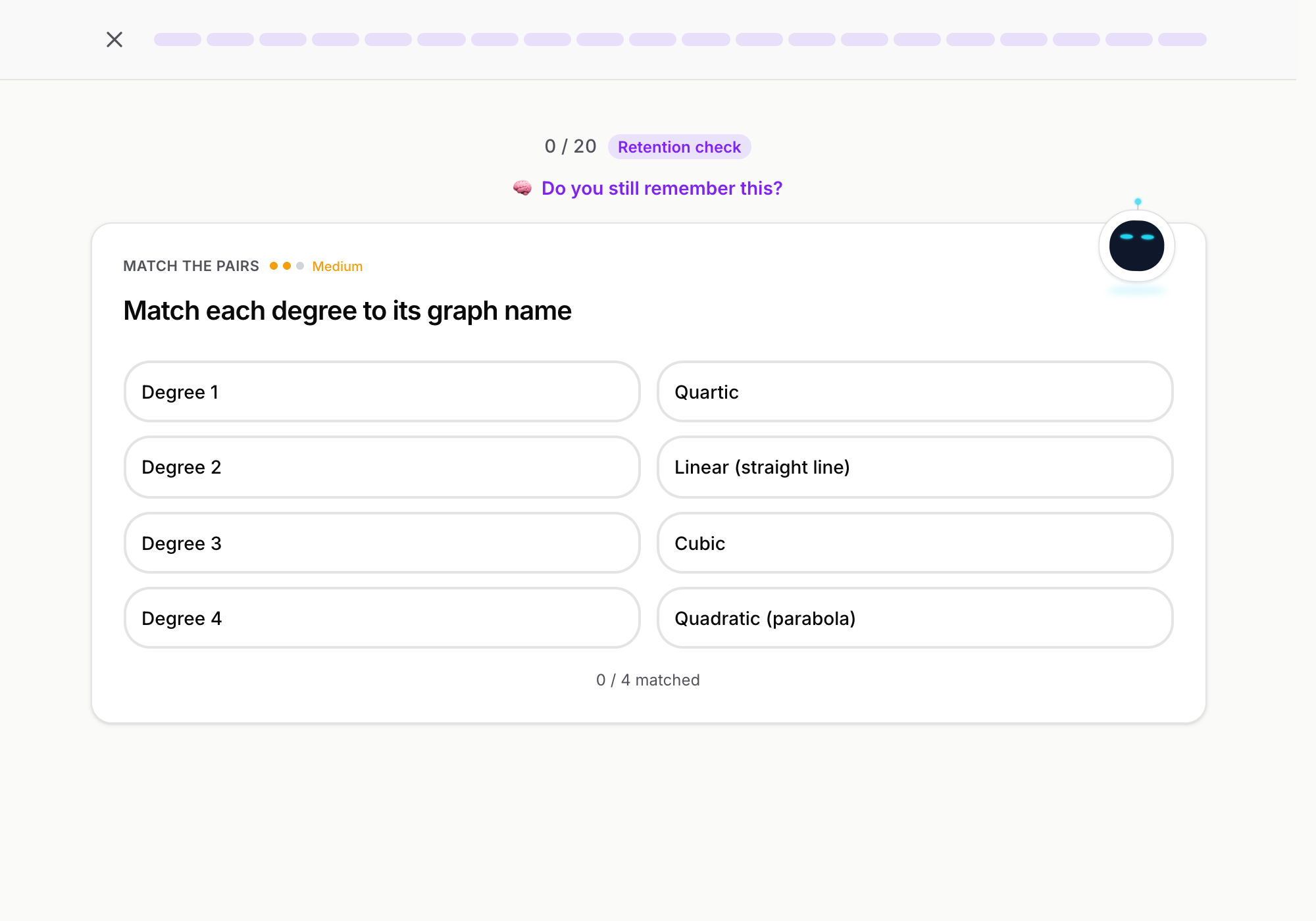
A Viden retention-check question — matching each polynomial degree to its graph.
Why schools pick it up

Three problems every senior school owns. One tool that answers all three.

Policy — VTLM 2.0

It implements what the Department already asks for.

Every Victorian government school is expected to embed VTLM 2.0 by 2028 — a model that names retention and recall and spaced, varied and repeated practice in its elements of learning. Viden operationalises exactly those elements, outside class time.

Outcomes — attainment

Completion is solved. Attainment isn't.

VCE completion sits at 97.4% — but only 8.8% of study scores reach 40+. The gap between finishing and performing is where a school moves its results, and durable recall at exam time is the lever.

Workload — teacher time

Formative data with zero marking.

Secondary teachers work a median 50-hour week; almost 1 in 4 marks 10+ hours of it. Viden produces class-level diagnostic data as a by-product of students revising — nothing marked, nothing built by staff.

The product

A five-minute daily loop. A live picture of the whole class.

Students retrieve what they're about to forget. Teachers see exactly where the class is weak — before the SAC, not after it.

01 · For students

Retrieval, then feedback — the two strongest levers there are.

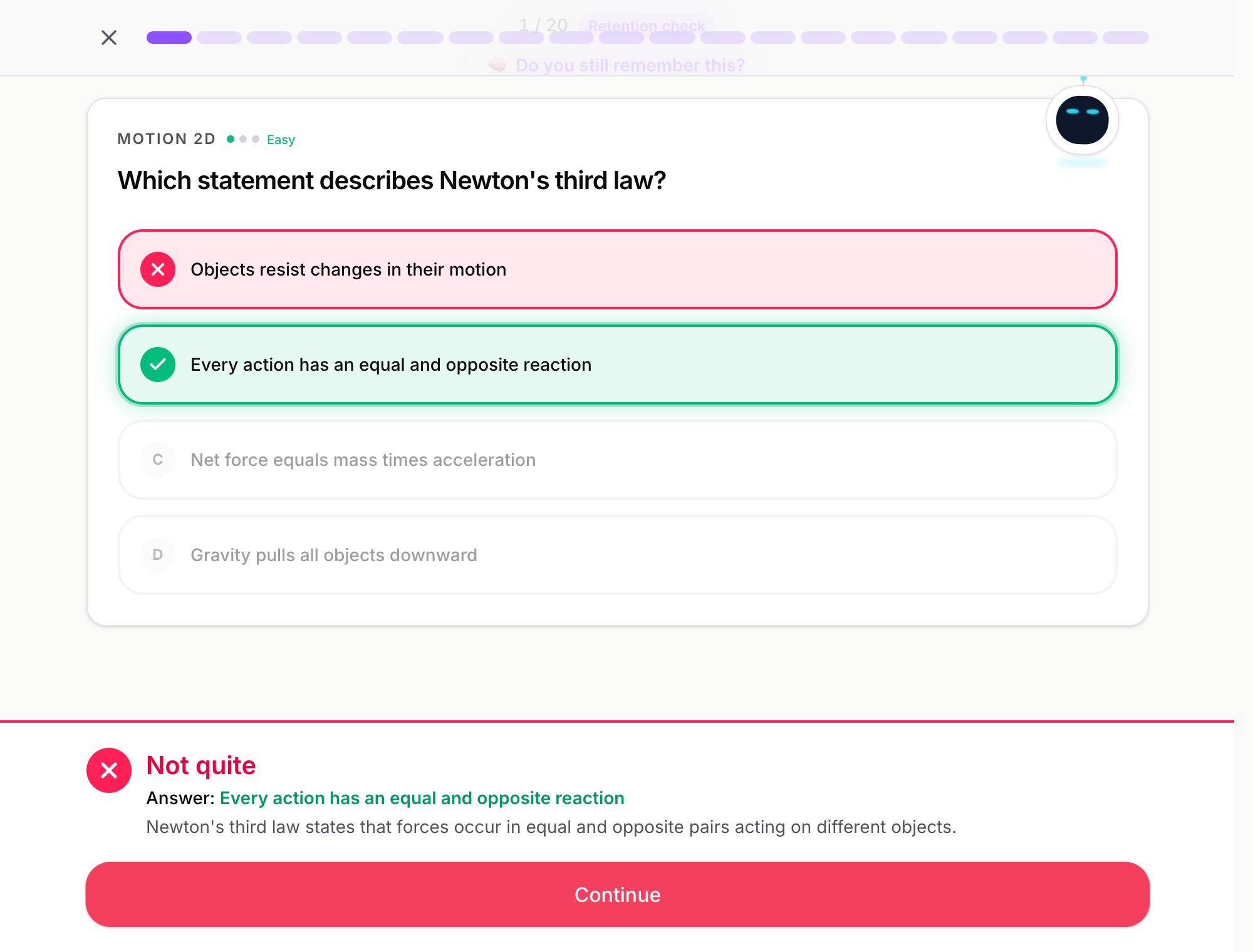
Every session asks a student to recall, then answers back: right or wrong, each question is met with the correct response and a written explanation, so a mistake becomes the moment the concept sticks. A scheduler surfaces each item at the moment it's about to slip.

  • Immediate feedback and a worked explanation on every answer
  • Short sessions that fit the gaps in a school day
  • Wrong answers return sooner; mastered ones stretch out
Feedback on a Physics question: 'Not quite', the correct answer highlighted, and a written explanation of Newton's third law.
A wrong answer produces the reasoning, not just a cross — and the item comes back sooner.
02 · Memory, made visible

Every item has a memory state.

Nothing in Viden is "done". Each concept moves through New → Learning → Familiar → Proficient → Mastered, decays if it's neglected, and is re-checked long after it was first learned — so what a student sees is what they'd actually retrieve on exam day.

  • Reviews due, ranked by urgency
  • Long-term retention checks on old mastery
  • Per-topic strength, so revision targets the slipping topic
Viden's memory chart showing decay and recovery, with per-topic mastery bars beneath.
Each review resets the decay curve and lengthens the interval before the next one.
03 · For teachers

The revision lesson, planned for you.

The class view ranks every topic by first-try accuracy and names the ones that need urgent revision — with SAC-specific and exam-wide recommendations at the top. Flip to the student view to see who is quietly falling behind before it shows up in an assessment.

  • Class setup in a minute — students join with a code
  • No student email addresses, no IT rollout
  • Scoping enforced in the database, not the interface
Teacher class view ranking topics by first-try accuracy with Management Styles flagged as needing urgent revision.
Management Styles at 47% while the cohort sits above 70% — that's Tuesday's revision lesson, decided in ten seconds.
04 · Coverage

45 of 50 VCE studies, Units 3 & 4.

Content is structured against the current VCAA study designs — Units 3 and 4, area of study by area of study, topic by topic. Not a generic international syllabus with a Victorian sticker on it.

  • 150,000 practice questions across the full course
  • Sequenced to the study design a teacher actually teaches
  • Updated when VCAA revises a design
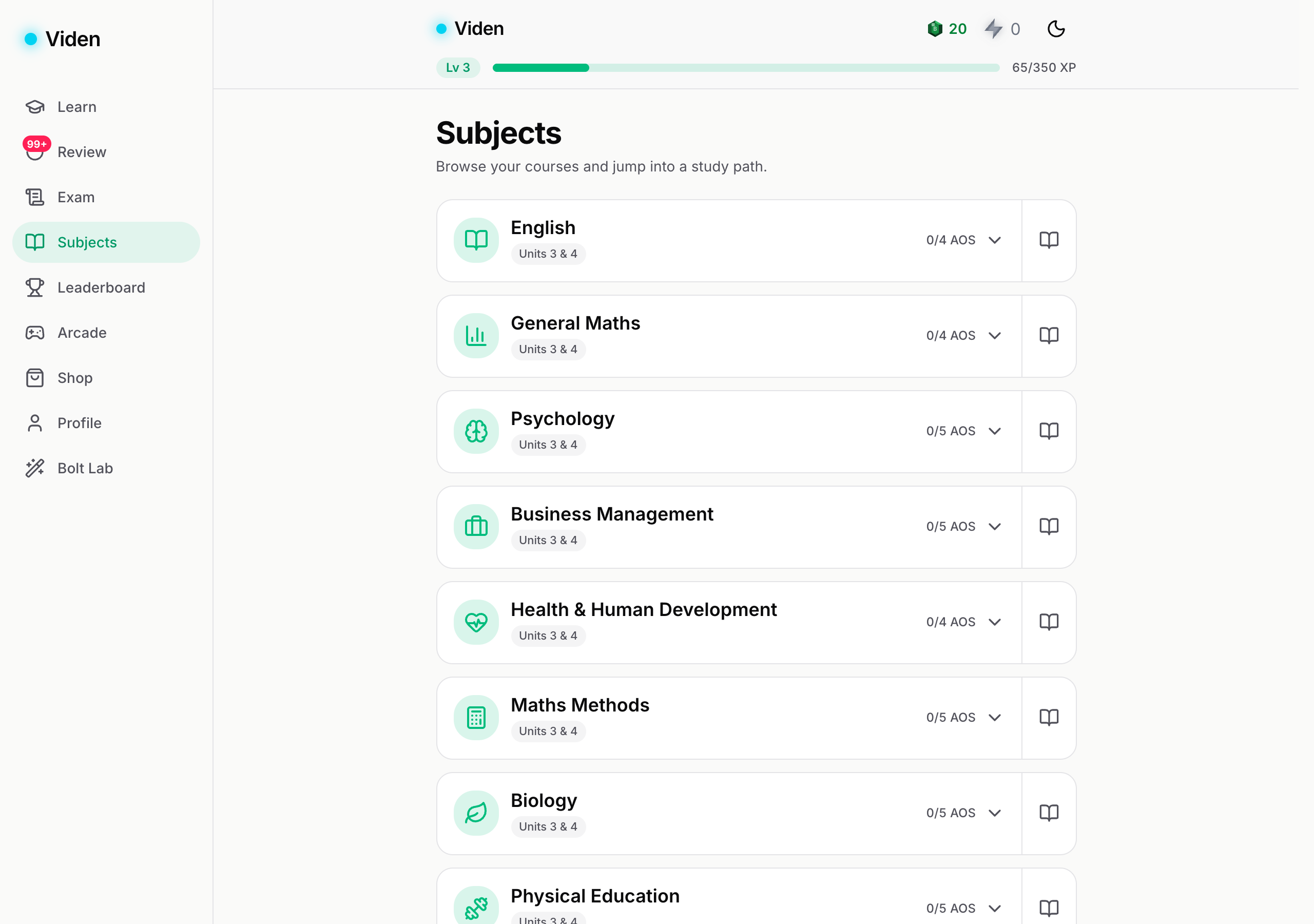
Viden's subject list showing all 50 VCE studies across Units 3 and 4, each with its areas of study.
Structured against the current VCAA study designs, subject by subject.
Design position

We took the scheduling. We left the rest.

The mechanics that make feed apps hard to put down are not one thing — some are scheduling, some are harms. Viden is explicit about which it uses.

Deliberately not in Viden

  • No infinite scroll or algorithmic feed
  • No user-to-user social features, chat, or public profiles
  • No user-posted content
  • No notification pressure outside a student's own study window
  • No loss-aversion or punishment mechanic for a missed day
  • No advertising, and nothing sold to students

What Viden does use

  • Short sessions that fit the gaps in a student's day
  • Immediate, specific feedback on every answer
  • Scheduling that returns an item as it's about to be forgotten
  • Visible progress, framed as what the student now knows
  • Difficulty matched to current mastery
  • Forgiving consistency — recovery, not penalty

Why this matters in Victoria. Device restrictions extend to every Victorian school — including Catholic and independent — from 28 January 2027. Viden is an at-home and school-device consolidation layer, built as a web application rather than a mobile phone app — it runs in the browser on any laptop, school Chromebook, tablet or phone, with no app-store install and no device permissions to manage. It is not a classroom-phone product, and it supports device-free teaching rather than competing with it.

The science

This is a memory product before it's a learning product.

The VCE problem isn't comprehension — it's retention across eight months. Content taught in February is examined in October. Two findings address exactly that constraint, and Australia's own national evidence body has already made the case.

“An overwhelming amount of evidence suggests that retrieval practice in the form of low stakes practice testing increases achievement.”

AERO — the Australian Education Research Organisation: the national evidence body established by Australia's education ministers, and the body Victoria developed VTLM 2.0 with. Spacing and retrieval practice guide (2021, updated 2024)

“Massed practising or ‘cramming’, where material is practised in a single session, is less effective for durability and mastery.”

AERO, How students learn best (2023)

“If a student cannot recall the information, it helps the teacher identify learning gaps or misconceptions.”

AERO, How students learn best (2023) — the teacher dashboard, described before we built it

What spaced retrieval does to a memory

Memory fades on its own. Each retrieval resets the curve and slows the next decay — so the interval between reviews stretches from days to weeks to months.

With spaced retrievalWithout review
0% 50% 100% Feb Oct — exam still retrievable forgotten

Illustrative — the shape, not measured data. The replicated finding behind it: Murre & Dros (2015) reproduced Ebbinghaus's forgetting curve; Cepeda et al. (2006, 317 experiments) showed the optimal review interval grows as the retention interval grows.

The highest-leverage practices — and the ones Viden delivers.

Standardised effect sizes on achievement, from the meta-analytic literature. The single most powerful influence in the research — feedback — is exactly what Viden does on every question.

Delivered by Viden The teacher's work — Viden frees the time for it

Feedback and formative assessment are the two highest-leverage practices in the evidence — and both are what Viden delivers: an explanation on every answer, and a live class picture for the teacher. Sources: Hattie & Timperley 2007 (feedback) · Hattie 2009 via NSW CESE (explicit teaching) · Mawson & Kang 2025 (spacing) · Yang et al. 2021, 222 studies / 48,478 students (retrieval).

The detail, for whoever wants it

Retrieval practice — the strongest card in the deck +

Across 222 studies of 48,478 students in real classrooms, practising recall produced d = 0.499 over other study methods (Yang et al., Psychological Bulletin, 2021). A separate synthesis of 217+ studies found the effect was larger in classrooms (g = 0.67) than in laboratories — and that secondary students benefited more than any other age group (Adesope et al., 2017). A mixture of question formats beat any single format.

On real high-stakes exams: low-stakes quizzing improved end-of-semester exam results against re-reading (Roediger et al., 2011), with 13–25% gains on summative unit exams in middle-school science (McDaniel et al., 2011).

Spaced practice — why it fits the VCE specifically +

A 2025 meta-analysis restricted to classroom studies (N > 3,000) found d = 0.54 for distributed over massed practice — and the advantage grew as the retention interval grew (Mawson & Kang, 2025). That moderator is the whole VCE argument: there is no gap in Australian schooling longer than the one between a Unit 3 SAC and the end-of-year exam.

AERO's honest caveat, which we'd rather state than hide: the exact interval matters less than spacing at all — “the specific length of the time… is not as important as ensuring that you use spacing in the first place.”

Test anxiety — the objection, answered by the data +

The obvious worry about a quiz-based product in Year 12 is that it adds pressure. The classroom research found the opposite: in programs of regular low-stakes retrieval, 92% of students said it helped them learn and 72% reported feeling less nervous about tests (Agarwal et al., JARMAC, 2014). Low stakes are the mechanism — nothing in Viden is graded.

Formative assessment — the equity result +

NSW CESE's What Works Best records formative assessment at an effect of 0.4–0.7 — “larger than most education interventions” — and notes that it “helps ‘low attainers’ more than other students, and so reduces inequities in attainment whilst also raising attainment overall” (citing Black & Wiliam's review of 250+ studies).

CESE is also candid that evidence linking data use specifically to student improvement still needs more rigorous study. That caveat belongs here as much as the finding does.

The attention context — stated carefully +

OECD PISA 2022: 65% of students report being distracted by digital devices in at least some maths lessons, and those distracted in most or all lessons scored 15 PISA points lower. Australians aged 15–17 average 4+ hours a day of recreational screen time — excluding study (ABS 2023). A 71-study meta-analysis (98,299 participants) associates short-form video use with poorer attention, r = −.38 (Psychological Bulletin, 2025).

Stated carefully because it must be: these are associations, not proven causes, and none of it means teenagers are broken. Feed products run variable-ratio reward schedules — the same unpredictable-payoff structure as poker machines — and a schedule is a neutral instrument. Viden points the same scheduling at a retrieval question about Unit 3.
Victorian alignment

The Department wrote the spec. Viden ships it.

VTLM 2.0 is being progressively implemented from 2025 and fully embedded in all government schools by 2028. Its own words, beside what Viden does — so you can judge the fit yourself.

Viden is not endorsed, approved or certified by the Department of Education — no such scheme exists. These are the Department's published policy texts, quoted directly.

VTLM 2.0 — Retention and recall

“Practice using new information facilitates transfer to long-term memory and retention. Recalling new knowledge strengthens the connections in long-term memory and makes it easier to apply.”

In Viden

Every item is answered by recall, not review. Each response updates the item's memory state, and the interval before it returns lengthens as the memory strengthens.

VTLM 2.0 — Mastery and application

“Spaced, varied and repeated practice consolidates learning, builds neural connections, supports transfer of learning to new situations and leads to ever more complex mental models.”

In Viden

The scheduler is the product. Items are spaced across weeks and months, varied across areas of study, and repeated to mastery — then checked again long after.

VTLM 2.0 — Supported application

“Revisit and review” is a named evidence-based strategy within the model, supporting consolidation of knowledge built in previous lessons.

In Viden

Viden carries the revisit-and-review load outside class time — freeing lesson time for explicit teaching of new content rather than teacher-led recap.

FISO 2.0 — Assessment, dimensions 5 & 6

“Systematic use of assessment strategies and measurement practices to obtain and provide feedback on student learning growth” … “systematic use of data and evidence to drive the prioritisation, development, and implementation of actions in schools and classrooms.”

In Viden

The teacher dashboard is continuous formative data by topic and by student — generated as a by-product of revision, with no marking load created for staff.

FISO 2.0 — Teaching & Learning, dimension 3

“Documented teaching and learning programs based on the Victorian Curriculum and senior secondary pathways.”

In Viden

Content is structured against the current VCAA study designs — 45 of 50 VCE studies so far, Units 3 and 4, area of study by area of study.

0

VCE completion. Completion is not the problem a senior school is solving — attainment is.

VCAA, Senior Secondary Statistical Information 2025
0

of study scores reach 40+ (23,494 of 266,759). That distribution is where a consolidation tool moves a cohort.

VCAA, 2025
$1.2bn

Tutor Learning Initiative spend — and the Auditor-General found tutored students showed no greater learning gains.

VAGO, June 2024
We'd rather raise the VAGO tutoring report than have you raise it +

The Auditor-General found that students tutored under the $1.2 billion Tutor Learning Initiative in 2023 did not show greater learning gains than similar students who weren't — and among disadvantaged students, no difference at all. Fewer than a third of schools achieved fully effective practice; only 26% targeted the right students.

Read carefully, VAGO's findings were about implementation — targeting, teacher collaboration and curriculum alignment — not about whether practice and consolidation work. The learning science was never the failure point. That's exactly where Viden is designed: targeting is automatic (the scheduler surfaces what each student is closest to forgetting), curriculum alignment is structural (content is built against the VCAA study designs), and the teacher sees the class picture without collecting or marking anything.

International

Victoria has already decided this. Here's who else has.

The systems ahead of Australia in international assessment build consolidation into their curriculum design and their national infrastructure. VTLM 2.0 isn't a Victorian idiosyncrasy — it's the direction of travel.

PISA 2022 mathematics — where Australia sits

Mean scores, latest published cycle (Dec 2023). Nine systems significantly outperformed Australia — down from 22 in 2018, though partly because the OECD average fell while Australia held stable.

OECD PISA 2022 Volume I · ACER. PISA 2025 publishes late 2026.

Singapore's syllabus is deliberately spiral — “to enable pupils to consolidate the concepts and skills learnt and to further develop them.” And it has spent the last several years moving away from high-stakes exams toward frequent, low-stakes feedback — mid-year exams removed, weighted assessment capped at one per subject per term.

Singapore Ministry of Education — syllabus documents and parliamentary replies, 2022–2023. Frequent low-stakes feedback is precisely what Viden provides.

Estonia — Europe's top PISA performer, and one of its most equitable — runs digital revision as state infrastructure: a national learning-materials portal, a national e-assessment platform with a task bank and automatic marking, and leaving exams fully digital from 2027.

Estonian Ministry of Education and Research · Harno · EU Education and Training Monitor 2025. Estonia also answers the “they just cram” objection: no shadow-education industry, comparable results.
What the OECD actually attributes the difference to +

PISA associates higher maths performance with cognitive activation — asking students to summarise, question and predict, to link new information to prior learning, and to apply it in new contexts. That is a fair description of what a well-scheduled retrieval question does.

And the opposite, stated clearly because it's often got wrong: students in the highest-performing systems report using memorisation less, not more. Retrieval practice is not rote learning — it's recalling in order to strengthen memory and make knowledge usable, the same distinction VTLM 2.0 draws.

What we are not claiming +

The strongest finding in comparative education isn't about tools — it's that high-performing systems are built on teacher quality, professional autonomy and collaborative school culture, and the equity findings are structural. No revision product touches that. AITSL puts it plainly: “the quality of pedagogy has a more significant impact on student outcomes than edtech usage.” We agree.

AERO, CESE and the VTLM endorse the practice of spaced retrieval — none endorse this or any product, and no such scheme exists. And Viden's feedback is an immediate, worked explanation on every question — not a substitute for a teacher's individualised feedback, which the class dashboard is built to inform. Viden gives a teacher visibility into what a class has actually retained, and carries the revisit-and-review load outside lesson time so lesson time can be spent teaching. That is the whole claim.

Devices, internationally. The Netherlands, Korea and Finland have legislated classroom phone bans; UNESCO has called for them globally. Victoria's position is the mainstream, and Viden is built for it — revision outside instructional time, never a classroom-phone product.

Privacy, security & compliance

Built for the assessment a school will actually run.

Victorian policy requires schools to check for a Safer Technologies 4 Schools assessment before adopting software. Viden has been engineered against the ST4S 2025.1 framework from the beginning — and our policies are public.

Data minimisation by design

Student accounts hold a display name, class join code and password. No student email address. No date of birth. Nothing collected the product doesn't need.

Australian data residency

All personal information stored in Australia, primary infrastructure in Sydney. No student information disclosed overseas. Sub-processors named in the privacy policy.

Access control in the database

Row-level security enforced at the database layer, not the interface. A teacher reads only their own classes; a student only their own record.

Brute-force protection, live

CAPTCHA on login validated server-side on every attempt, plus a server-side rate limit on class join-code attempts. In production now.

Right to erasure

Deletion cascades through every related record. A removed student leaves no orphaned data behind.

Teacher-mediated credentials

No self-service password reset for students — a teacher issues and resets credentials, keeping the account lifecycle inside the school.

No ads, profiling or AI training

Personal information is never used for advertising, commercial profiling, or training third-party AI models. Nothing is sold to students.

Published policies

Our Privacy Policy and Terms of Service are public, name every sub-processor, and match our ST4S materials.

Stated plainly: Viden's ST4S assessment is in progress and not yet complete. This page does not claim ST4S certification, and we won't ask a school to adopt Viden ahead of that assessment. The controls above are implemented today and can be demonstrated on request.

Not an age-restricted platform — and why that's a design constraint we keep +

Australia's Online Safety Amendment (Social Media Minimum Age) Act 2024, in force since 10 December 2025, excludes services whose sole or primary purpose is education. Viden has no user-to-user social interaction and no user-posted content — it sits in the same regulatory class as a learning management system, not a social platform. That's a permanent design position, not a temporary state.

Why us

Built inside the system it serves.

AW
Alex Waugh
Founder · a current VCE student

Most edtech is built by people decades out of the classroom, guessing at what students do. Viden's founder is inside the VCE system right now — living the workload, the SAC calendar and the exam-year pressure this product exists to solve.

  • In the school system today. Viden's scheduling, content structure and student experience are tested against reality daily — not against a focus group's memory of school.
  • Evidence-led by temperament. Every claim on this page carries its source, including the ones that cut against us.
  • Melbourne-based, Victorian-first. Built for the VCAA study designs, the VTLM, and ST4S — not localised to them after the fact.
Get in touch

Have a look at it properly.

Happy to walk any principal, head of senior school or learning-and-teaching leader through the product and the teacher dashboard — and to share the evidence base above in full, with its citations.

NameAlex Waugh
BusinessAlex Waugh trading as River Wolf Enterprises
ABN80 950 686 903
Based inMelbourne, Victoria

← Back to River Wolf Enterprises